y-cruncher
Using y-cruncher, I calculated 175 billion digits of Gamma(1/5) with this laptop in my dorm (window open for ventilation):
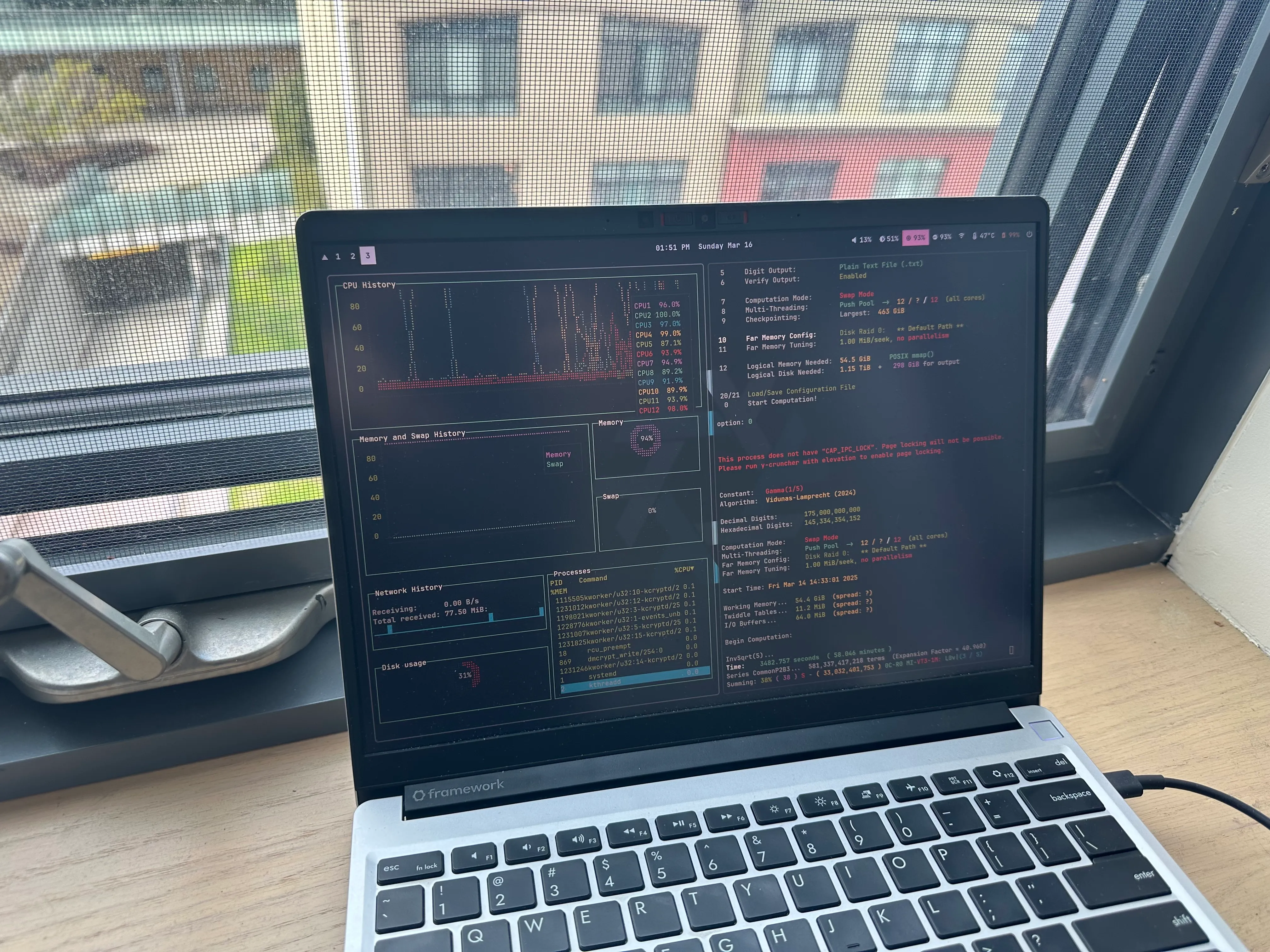
| Component | Specification |
|---|---|
| Processor | AMD Ryzen 5 7640U |
| Topology | 12 threads / 6 cores / 1 socket |
| Usable Memory | 62.0 GiB |
| Usable Storage | 1.14 TiB |
I ran the calculation twice to verify my results:
The first calculation used the Vidunas-Lamprecht (2024) algorithm provided by y-cruncher and was run on a framework laptop running NixOS.
where
A second computation, this time performing the Incomplete Gamma Approximation algorithm, matched the results of the first computation. Here are some interesting stats from these computations:
| Method | Read | Written | Computation Time |
|---|---|---|---|
| VL | 503 TiB | 443 TiB | 15 days, 22 hours |
| IGA | 356 TiB | 316 TiB | 52 days, 7 hours |
My understanding is that the first method (Vidunas-Lamprecht) is intrinsically more efficient than the Incomplete Gamma Approximation; however, most of the observed performance gap is due to hardware differences. The laptop had an NVMe SSD and a much newer CPU compared to the older hard drives and processor in the Debian server used for verification.
Over the two runs combined, more than 1.6 Pebibytes (PiB) of data (about 1.64 * 106 GiB) was read and written to disk. No I/O errors were detected, and all drives remain in full working condition.